
Product Watch / software review published; hardware not tested / Updated September 13, 2026
Zenframe Family Display Product Watch
Source-backed and software-tested notes on Zenframe Display and Display Mini, two European family screens for calendars, meals, household tasks, kids routines, photos, and AI-assisted planning.
Zenframe is a Norway-based family-management platform with optional 15.6-inch and 10.1-inch displays. The public product pages position both sizes as always-visible screens for family calendars, meals, tasks, kids routines, photos, clock, and weather. SmartFrameLab used a dedicated reviewer web account to check representative AI and calendar-subscription workflows. This remains a Product Watch without a review score because the physical displays, native apps and long-term household use have not yet been tested.
Quick answer
- Zenframe is an early-stage European family-display candidate, with a 15.6-inch main display and a 10.1-inch Display Mini running the same household content.
- The official English product data currently lists the two models at €329 and €229, one year of Zenframe Family included, and an in-stock signal; price, shipping, tax, and availability still need checkout confirmation for each country.
- The strongest reason to keep watching is the combined calendar, meals, tasks, kids-routine, photo, and AI-assisted planning system. Reviewer-account checks support the core web workflow, while hardware experience, native-app behavior and longer-term synchronization still need separate testing.
European family-display research path
Check sync, household workflows, and plan boundaries.
Zenframe combines calendars, meals, tasks, kids routines, photos, and AI-assisted planning. SmartFrameLab has tested representative AI and public-ICS workflows in a reviewer web account; hardware testing remains pending.
Calendar and command-center fit
- Zenframe Display ReviewRead the hands-on software findings, evidence limits, and current buying guidance.
- Calendar Sync SupportSeparate native sync, imports, ICS feeds, and two-way calendar behavior.
- Family Command Center vs Calendar FrameDecide whether the household needs a shared planning system or a simpler calendar screen.
Household workflow checks
- Chores, Routines, and Shared TasksCompare household ownership, child routines, rewards, and shared task visibility.
- AI Assistant ReadinessJudge AI tools by confirmed household outcomes, controls, and correction paths.
Plan and category boundaries
- Free vs Paid Feature BoundariesCompare the free Basis tier with the Family subscription after the included year.
- What Is a Smart Calendar Frame?Place Zenframe within the wider calendar-first family display category.
Product media
Display visual evidence
6 official media assets Used for feature context, not scoring weight.
Series map
Zenframe products in this watch list
2 models tracked Candidate paths are kept distinct from scored reviews and Best Picks.
Zenframe Display
Zenframe Display
- Role
- Main kitchen or household planning surface
- Screen
- 15.6-inch touchscreen
- Status
- Official site currently signals in stock
- Price signal
- €329 on the official English product data; regional prices vary
Zenframe Display
Zenframe Display Mini
- Role
- Smaller hallway, child-room, or secondary display
- Screen
- 10.1-inch touchscreen
- Status
- Official site currently signals in stock
- Price signal
- €229 on the official English product data; regional prices vary
Source-backed watch notes
What we verified
Manufacturer sources, supplied media and reviewer web access checked September 13, 2026. AI context, a shopping approval, a synthetic school-notice image, HTTPS and webcal subscriptions, and all-day events were tested; physical display performance remains untested. Checked September 13, 2026
What Zenframe is
Zenframe combines a family-management service with optional always-visible displays. Its category fit is closer to a family command center than a photo-only frame because calendars, meals, household responsibilities, child routines, and planning tools share the same system.
- The 15.6-inch model is positioned as the main family surface; the 10.1-inch Mini is positioned for smaller spaces.
- Both models are described as showing the same Zenframe content rather than offering different software tiers.
- SmartFrameLab is tracking the pair as one product family until testing shows a meaningful workflow difference beyond screen size and hardware capacity.
Calendar and family workflow checks
Zenframe clarified its calendar connections in writing on September 12, 2026. Google Calendar uses an account-level OAuth connection with read-only scopes. Apple/iCloud and Outlook use calendar subscriptions rather than native account integrations. SmartFrameLab then connected two independent public ICS feeds in the reviewer account, confirmed that their events appeared, ran a manual sync and removed both test subscriptions. The stated automatic refresh interval still needs a timed test.
- Google Calendar imports are one-way into Zenframe. Events created or edited in Zenframe are not written back to Google.
- Apple/iCloud import requires a public ICS calendar link; Zenframe says the read-only subscription refreshes about every 30 minutes. There is no native CalDAV connection. Outlook support is also via calendar subscription. The two public ICS tests support the general subscription path, while provider-specific setup still needs separate checks.
- Imported event title and time were read-only in the tested view, while a local household annotation could be added. Removing the test subscriptions cleared their calendars after a short interface refresh delay.
- An outbound secret, revocable ICS feed lets other calendar apps subscribe to the Zenframe family calendar. Two separate subscription directions do not provide two-way event editing.
The subscription boundary
Zenframe gives buyers a useful post-inclusion fallback: the official FAQ says the display retains calendar, photos, clock, and weather through the free Basis tier after the included first year. The buying decision is therefore whether meals, kids tools, tasks, assistant functions, and events justify restarting Family.
- Nothing should renew automatically after the included year according to the current official FAQ.
- The full Family tier is currently stated as 149 NOK per month, with no annual plan identified in the manufacturer brief.
- Plan contents and regional pricing should be refreshed before a scored review or subscription comparison.
What the supplied media shows
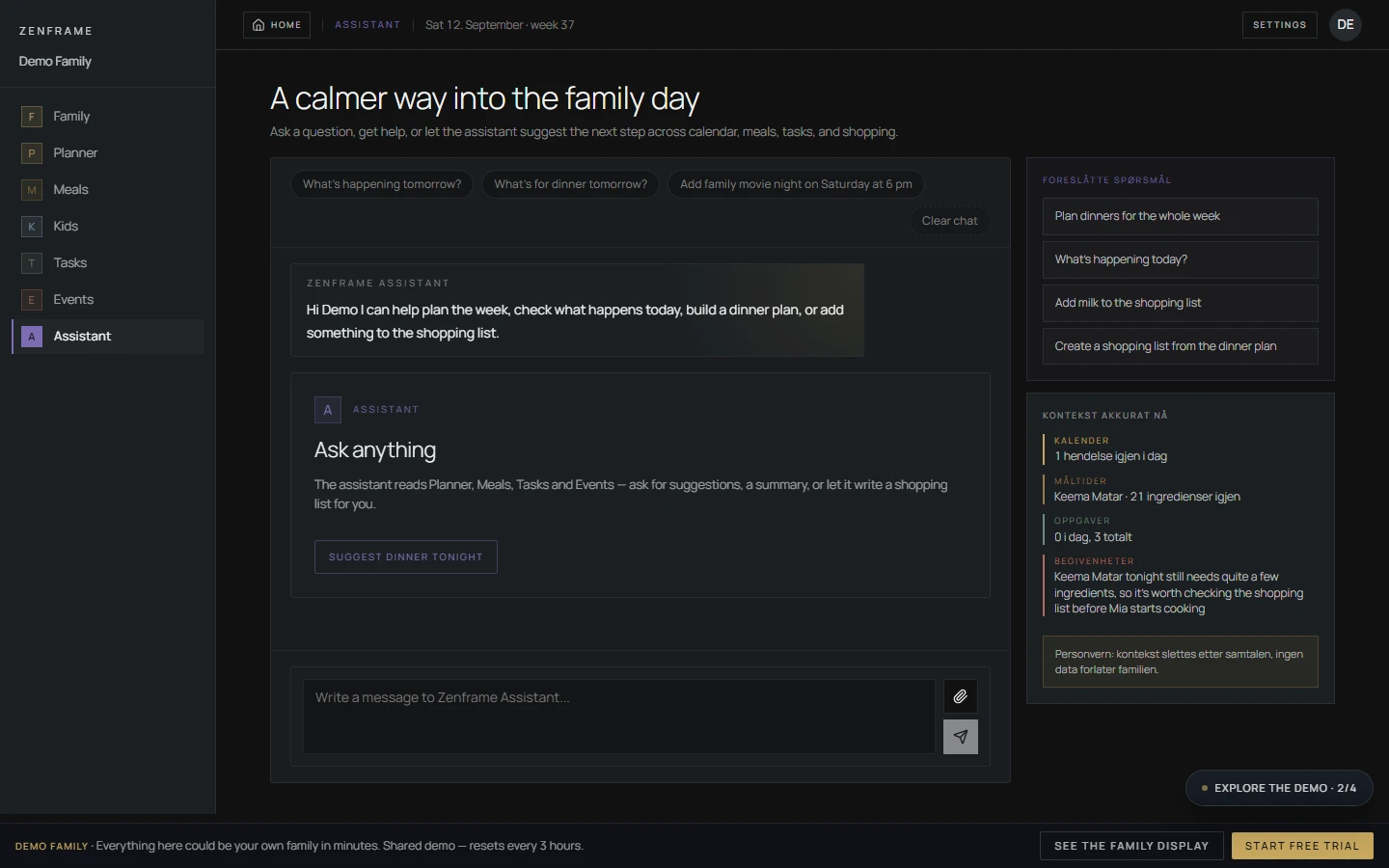
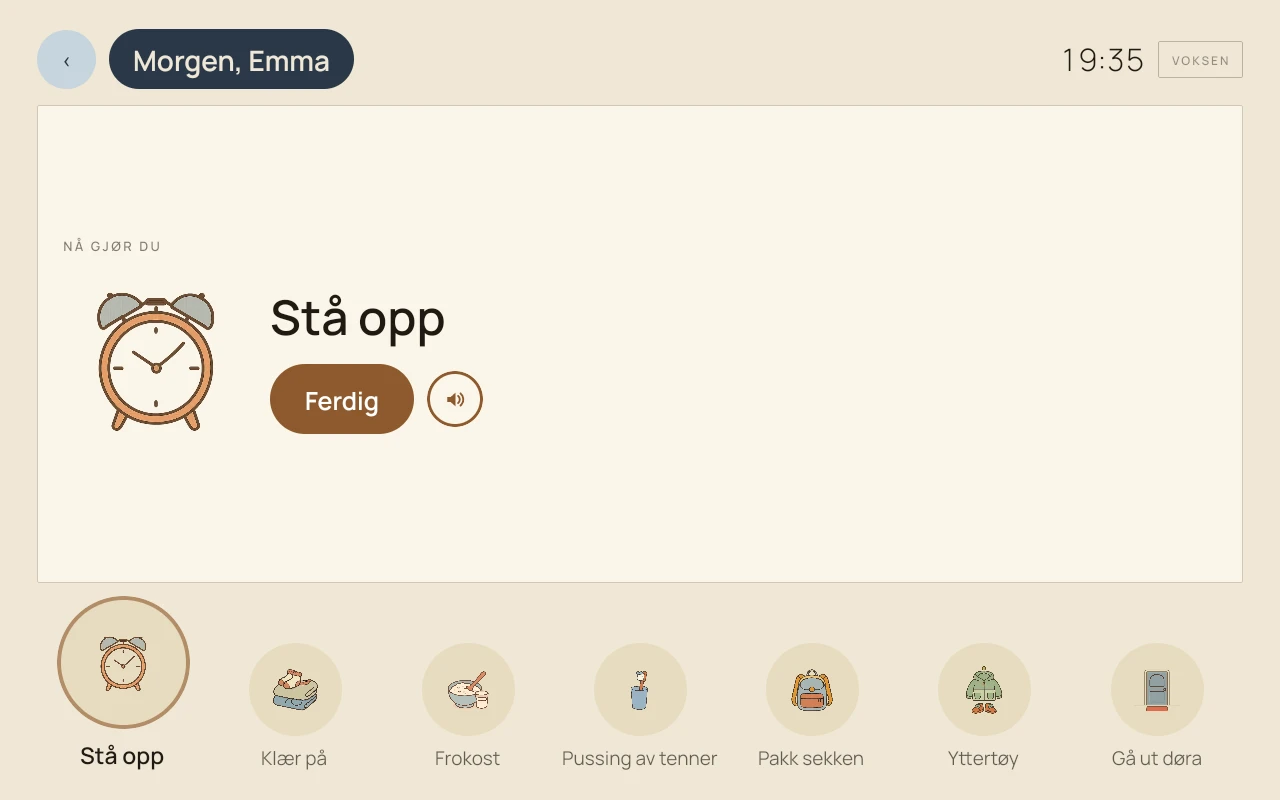
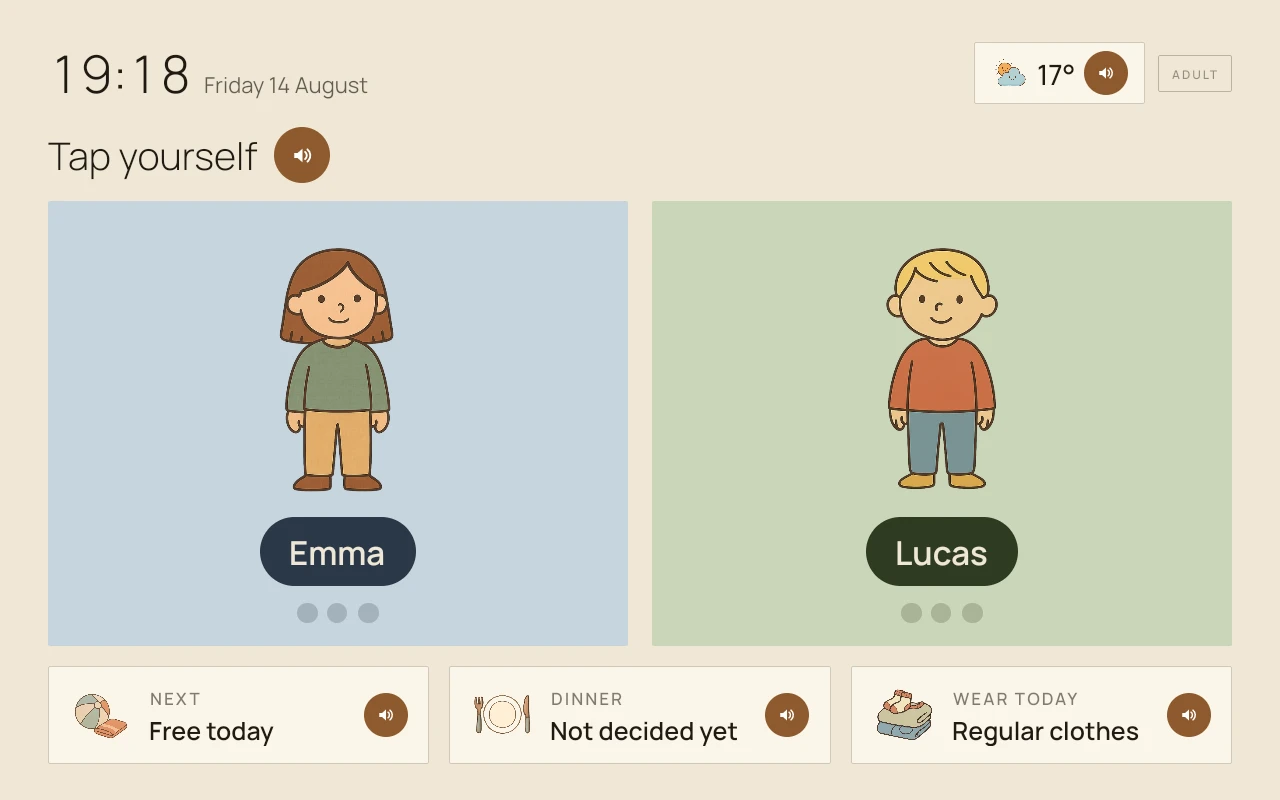
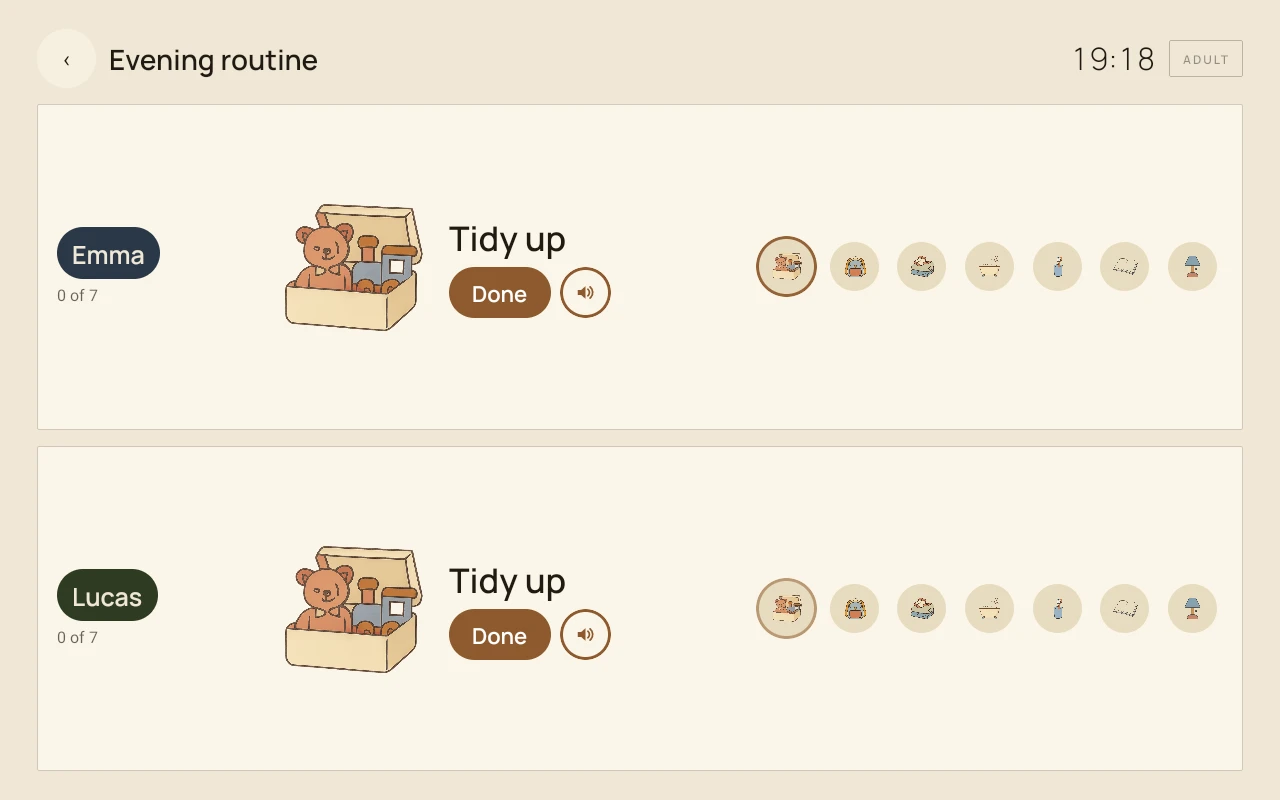
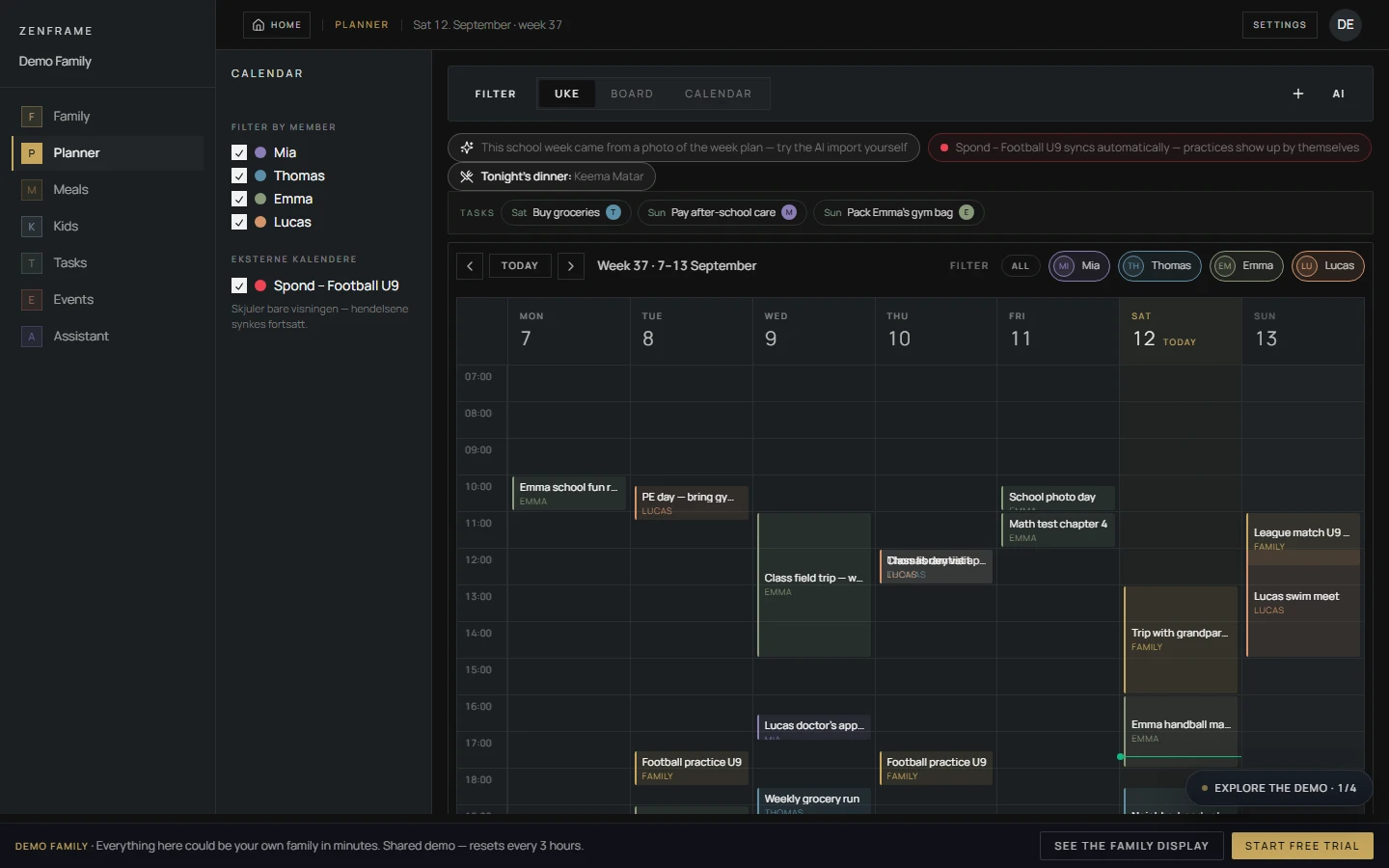
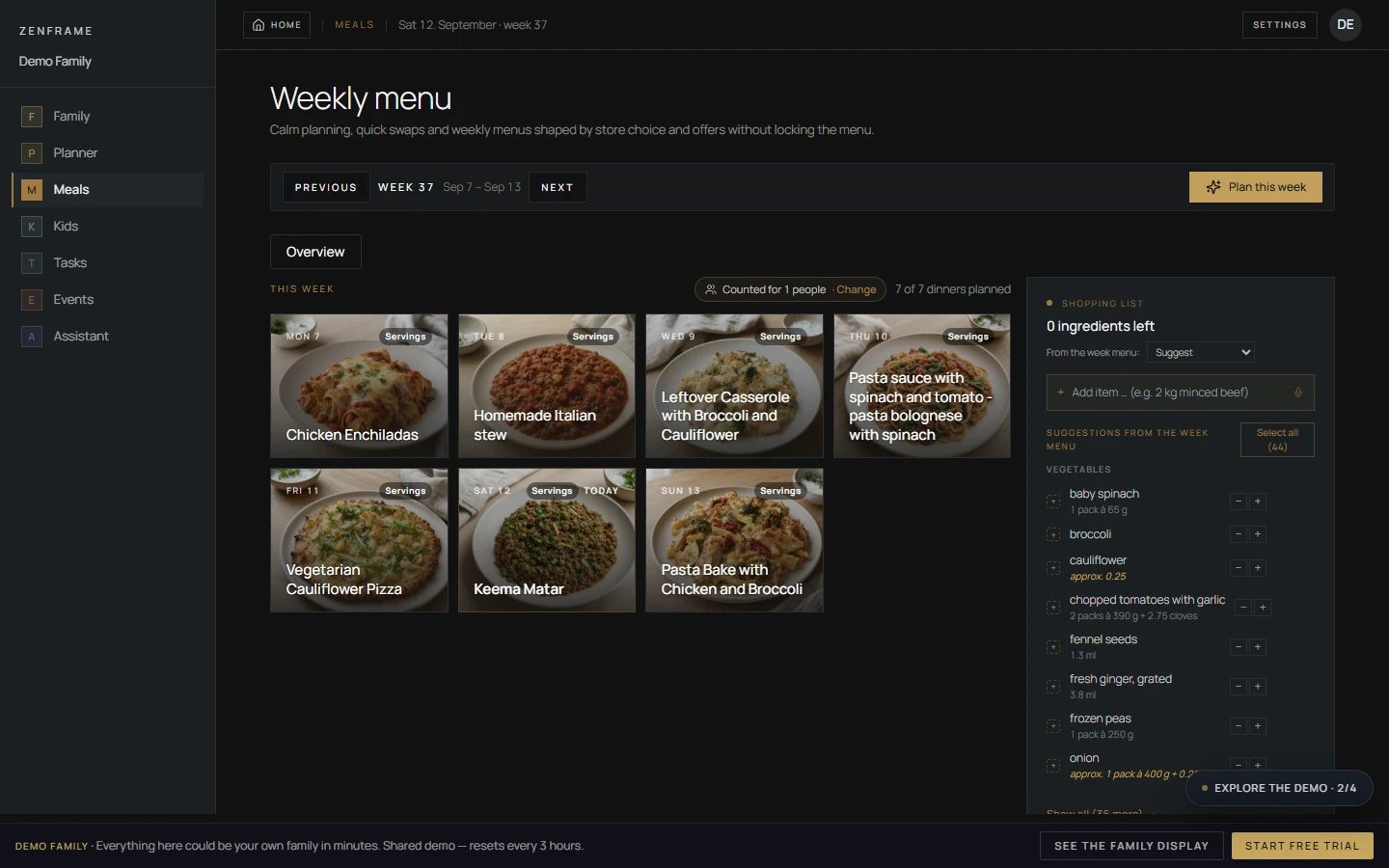
The selected media shows a wall-mounted display, the AI assistant, a step-by-step morning routine, Kids interfaces and the web calendar and meal planner. Zenframe identifies the panel images as captures from real displays and the web images as demo-family screenshots. The hallway photograph has supplier edits and blurred names. These materials add useful product context, while touch response, screen quality, speaker quality, mounting and everyday reliability need physical testing.
- Photo and screenshot captions identify the supplier and the type of evidence. The web screenshots retain the demo badge; some labels remain in Norwegian.
- The supplied panel screenshots show August dates; they illustrate the supplied interface version rather than a verified September software build.
- Additional clear Mini hardware, side-profile and bracket-detail photographs would strengthen the hardware record. Variant clarification would also help identify the supplied tabletop photographs before use.
AI assistance across the family plan
AI-assisted household planning is a central part of Zenframe’s offer. The supplied assistant screenshot shows suggested questions about upcoming events and dinners, shopping-list prompts, a file-attachment control and a sidebar presenting family context. In the reviewer account, SmartFrameLab checked a contextual question, an approval-gated shopping-list action and a synthetic school-notice image.
- The assistant returned a useful answer based on the visible calendar, tasks and meals in the seeded reviewer family. This was a focused scenario rather than a broad accuracy benchmark.
- A request to add two liters of milk produced an approval step before the shopping-list tool ran. After approval, the item persisted with its quantity and unit; the temporary test item was then removed.
- After Zenframe corrected the reviewer account language, the main interface and a typed Assistant response appeared in English. A valid PNG with a nonstandard file extension was accepted and produced the expected date, child assignment and bring-along note, so the earlier file-type rejection did not recur.
- The retested event still stored its English source title and note in Norwegian. The account setup explained part of the first result, but imported-content language remains open. As before, the upload wrote directly without the shopping action’s separate approval card.
- The assistant described the notice at 10:00 while the calendar rendered 16:00 in a different timezone context. The offset is consistent with timezone conversion, but clearer timezone labeling would make the two surfaces easier to reconcile.
- The morning-routine image shows a separate child-facing step interface. It does not demonstrate that AI generated the routine.
What the reviewer account established
In a September 13, 2026 browser session, SmartFrameLab completed onboarding in a dedicated reviewer account and explored the calendar, meals, tasks, kids, events and assistant modules. The account supplied enough connected family context to test read-only questions, approval behavior and calendar subscriptions without presenting the result as a physical-display review.
- The AI answer matched the seeded plan visible during the test, and the shopping item remained saved after explicit approval.
- HTTPS and webcal public ICS feeds connected successfully, appeared as external sources and displayed all-day events. A manual sync reported updates; the test did not wait long enough to measure the claimed automatic refresh interval.
- The Google OAuth launch requested read-only calendar event and calendar-list scopes. Calendar selection and import remain untested because no separate Google test account was granted.
Privacy disclosures are still being aligned
On September 13, 2026, the App Store listing still displayed Data Not Collected. In its September 12 reply, Zenframe said that label needed correction and described collection of account details, photos, audio, calendar events, tasks, meals, notes, push tokens, interaction data and crash data. The detailed response is useful, while the public store labels should be checked again after the planned updates appear.
- Zenframe names external AI and speech providers, including Anthropic, ElevenLabs, OpenAI and Deepgram. Its no-advertising and no-model-training statements remain manufacturer claims, not an independent data-flow audit.
- The manufacturer also says Google Play currently omits some content and diagnostic categories. Store disclosures and the privacy policy are therefore best read together until the updates are visible.
- The reviewer settings exposed controls for logs, proactive AI, family memory and per-member sharing. The interface also says medical-category notes are never shared automatically with AI. These controls add useful context, but they do not replace the public disclosure updates.
What the current evidence cannot answer
The reviewer account supports an evidence-based software review, but broader calendar connections, app and display coverage are still needed for questions about reliability and hardware quality. Google OAuth completion, timed subscription refresh, recurring-event handling, task and routine delivery, native-app behavior and real display hardware remain outside the current verdict.
- Complete Google OAuth and provider-specific Apple/iCloud and Outlook setup alongside the verified HTTPS and webcal subscription paths.
- Check mobile-to-web-to-display propagation, routine rewards, voice and document approval consistency using native access, supplied videos and, when available, physical hardware.
- Reconcile the App Store and Google Play privacy disclosures with Zenframe’s detailed explanation of data processing and AI providers.