
Kickstarter campaign · unscored / Updated November 6, 2026
Yahyah Portrait: A Living AI Frame with Connected Chat

A wooden character portrait with local recognition and a no-subscription core. Compare its privacy controls, online conversation, future extras and Kickstarter conditions.
Yahyah is an unusual alternative to a conventional slideshow: a character occupies the frame and invites repeated interaction. The stronger reason to follow it is the portrait-like form and physical camera cover. The important buying limit is that local sensing does not make its conversation service fully offline. Consider it as interactive character art at the crowdfunding stage, with the included experience and service dependence weighed separately.
Quick answer
- AI chat requires Wi-Fi; the creator distinguishes it from on-device recognition and wake-word functions.
- A physical camera cover is a concrete control. It does not by itself establish microphone muting, transcript deletion or offline conversation.
- Follow it for character interaction. Choose a connected photo frame for family uploads, or a calendar screen for shared schedules.
Product media
Portrait visual evidence
2 product images
Source-backed watch notes
Product details
Updated November 6, 2026
What a “living portrait” adds to a frame
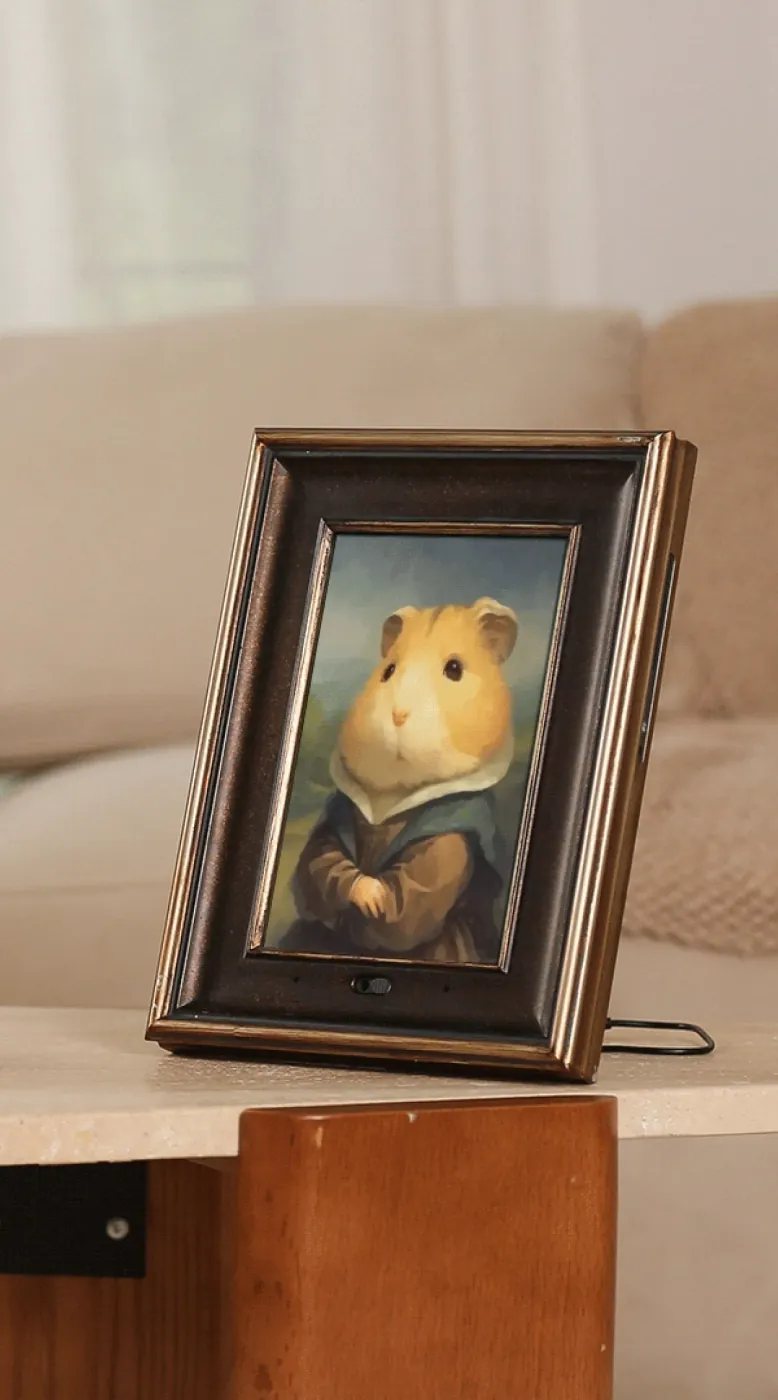
Yahyah puts the character at the center of the display. The maker describes a personality that develops with conversation and responds to people, touch, gestures and its surroundings. The attraction is returning to the same presence in a room, rather than choosing a different photograph each morning. That makes the daily question unusually personal: do you still want this character talking to you after the novelty wears off? An animated face can make a response feel warmer, but it does not establish better factual answers or reliable understanding of everyone in the household.
- A household interested in interactive character art is a more natural fit than one simply trying to receive holiday photographs from relatives.
- Choose a character that everyone using the room can tolerate, including someone who would prefer the screen to stay quiet.
Local recognition does not mean offline conversation
The October 27 company announcement describes conversational processing on a local server rather than a third-party cloud. The creator’s November 3 FAQ is more specific: recognition and wake-word processing are on-device, but AI chat requires Wi-Fi access to LLMs. For a buyer seeking fully offline dialogue, that later boundary is decisive. “Local server” alone does not identify whose computer runs a conversation, where it is hosted, or what speech leaves the frame. An NPU rating measures a component’s advertised computing capacity; it is not a map of the whole service.
- Separate the camera image, facial template, microphone audio, transcript, generated reply and saved memory when considering privacy. A statement about one does not describe all the others.
- For a privacy-sensitive room, use only a conversation mode whose data handling you accept. Encryption protects data in particular stages; it does not by itself say which service can process it.
A shutter helps with the camera, not every kind of recording
The physical sliding camera cover is a useful feature because its closed position can be checked without navigating a menu. It answers a narrower question than whether the portrait is listening or retaining a previous discussion. Covering a lens cannot mute a separate microphone, erase saved memories or stop a connected service from handling an already-sent request. Treat the privacy controls as separate actions rather than assuming one visible shutter manages the entire device.
- When viewing a demonstration, ask to see camera cover, microphone control and a quiet interaction mode separately.
- A helpful household setup makes it obvious when a guest is near an active camera or microphone. The comfort of visitors matters as much as the main owner’s settings.
Persistent memory needs more than a convincing demonstration
The website’s growing-personality pitch is appealing precisely because it makes previous conversations feel consequential. For a shared home, the harder question is ownership: can the character keep one person’s preferences separate from another’s, and can that person remove a mistaken or sensitive memory? Recognition is not proof of a secure personal account. A visitor resembling a family member, an overheard remark or a name correction could change what the portrait believes it knows.
- A useful demonstration returns to the same topic later, corrects a false preference, and shows what a second person hears. A friendly first response is only the beginning.
- Before using it for sensitive conversations, consider how you would inspect, clear and transfer its history. Remembering more is not always the desired outcome.
Wood and matte glass serve a different job from photo fidelity
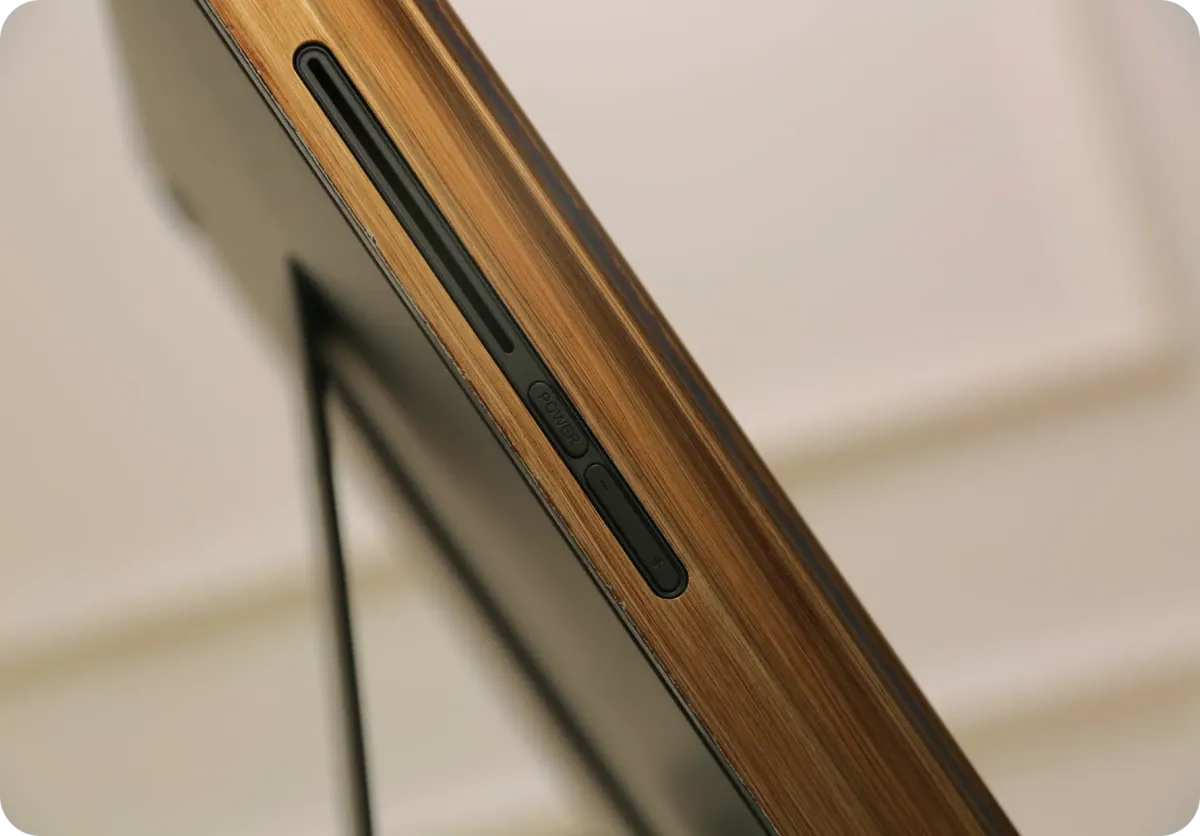
The official hardware sheet lists a matte, LED-backlit, multi-touch screen. Matte treatment can make the object feel closer to framed art, while touch and sensors support interaction. A marketing image cannot establish reflection control beside your own window, comfortable night brightness or natural-looking skin tones. The side-control photograph is useful for identifying the object, not for judging how the display behaves in a bright living room.
- Compare a dark scene, a face and fine artwork detail at the actual viewing distance. Check whether the character remains legible when room light falls directly on the surface.
- A light sensor does not establish a smooth dimming curve, a useful minimum brightness or predictable sleep behavior. Camera recognition and ambient-light detection solve different problems.
A battery rating is not an evening of cordless use
The specified 2,000mAh battery may be helpful when moving the portrait, but capacity alone does not tell you how long the display, speakers, wireless connection and processor will run together. A static artwork mode and an active conversation can place different demands on a battery. For regular placement, plan access to USB-C power and a sensible cable route rather than designing a room around an assumed all-day runtime.
- For a cordless demonstration, note brightness, sound level, wireless state and the mix of conversation versus idle display.
- Avoid treating a battery-equipped LCD as equivalent to an e-paper frame that holds a still image with very little ongoing display power.
The no-subscription promise has a defined starting point
The November 3 FAQ promises four included core characters without subscription or usage fees. It separately says custom characters, voice cloning, smart-home control and personal agents are future work that may cost extra. Buy for the included experience, not the possibility of every later feature being free. Our free-versus-paid feature comparison helps separate an initial entitlement from optional services.
- A three-year budget starts with the delivered pledge cost, then adds selected extras, applicable taxes, payment conversion, power and any separately required service. A five-year budget uses five years of the recurring items.
- A zero recurring fee for the starting feature set is useful, but connected conversations still depend on service availability. Ownership of the wooden frame does not guarantee that a remote inference service will operate indefinitely.
A reservation, a pledge and a delivered product are different
Yahyah’s separate launch site still describes a $10 reservation with campaign benefits. That amount is not the price of the finished portrait. Use the selected Kickstarter reward for the actual pledge, destination and delivery conditions; do not treat a launch-day promotion or a reservation graphic as today’s available tier. This is a campaign-stage product, so a fixed-date gift is better served by something already shipping.
- The creator’s November 3 FAQ aims to ship before the following May and promises a refund if hardware cannot ship. Both are creator commitments, not completed fulfillment or an independent guarantee.
- Check the selected reward’s currency, included character content, destination, shipping, tax and support coverage before paying. A country shown in a campaign selector is not a delivered duty-paid quote.
- Kickstarter explains that backing supports development rather than functioning like a normal store purchase. A creator’s return or refund statement still needs to be read in that context.
Yahyah versus Homture, musubi and a family calendar
These products use AI for different household jobs. Yahyah’s pitch is a recurring character relationship. Homture Magic Frame focuses on animating personal photographs; a picture moving is not the same proposition as a character keeping a conversational history. Looking Glass musubi focuses on prepared memories with a depth effect. If the real need is relatives sending new pictures each week, start with a connected photo-sharing workflow. For appointments, chores and pickups, use a family-calendar display rather than assuming that a conversational character can organize the household.
| Main job | More relevant starting point |
|---|---|
| A character to talk to and revisit | Yahyah, with its connected-chat and campaign conditions |
| Bring a personal photo to life | Homture’s photo-animation workflow |
| Display a prepared memory with depth | Looking Glass musubi |
| Show shared events and household tasks | A dedicated electronic calendar |
Different use cases, not a scored hardware comparison.
Who should keep Yahyah on the shortlist?
Yahyah is worth following if the character itself is the reason you want a screen in the room, and you are comfortable supporting a developing connected product. The wooden portrait format could make AI interaction feel less like opening another phone app. For someone prioritizing entirely offline conversation, a dependable shared calendar or a gift with a fixed delivery date, the current proposition is a poor match. The useful next step is to evaluate the specific experience being offered: a character you enjoy, controls you understand and a service boundary you can live with. Our AI assistant comparison distinguishes conversational appeal from the ability to complete family-planning tasks.
Choose the display’s job
Character conversation, personal photos or family planning?
Compare the daily experience you want before choosing the frame.
Related displays
- Homture Magic FrameAI photo animation rather than a persistent character.
- Looking Glass musubiPrepared memories with a depth effect.
AI and ownership
- AI Assistant ReadinessConversation versus useful task execution.
- Free vs Paid Feature BoundariesIncluded functionality, optional extras and ongoing services.